For three years, a band of women along with 12 men had the opportunity to literally walk with Jesus unhurried. They traveled by foot from village to village at a pace conducive to rich conversation as they took in the beauty of the surrounding countryside. We are given glimpses of their encounters at key moments along the way. What we don’t have recorded are the hours of conversation and silence they shared with Jesus, not unlike the experience of the two disciples walking 6 miles to Emmaus with Jesus following his resurrection. (Luke 24:13-32)
One by one and in pairs, Jesus’s band of pilgrims responded to his invitation to come and see where and how he lived (John 1:39). Jesus extended His welcome to ordinary villagers in Matthew 11:28-30: “Are you tired? Worn out? Burned out on religion? Come to me. Get away with me and you’ll recover your life. I’ll show you how to take a real rest. Walk with me and work with me—watch how I do it. Learn the unforced rhythms of grace. I won’t lay anything heavy or ill-fitting on you.” (The Message)
Everything Jesus entrusted to these men and women is now our inheritance. Jesus assured them and us that it is better that He ascend to His Father so that He is now free to interact with all of us in union with the Holy Spirit. What a precious gift! Now all of us no matter where we find ourselves can walk with Him at the same pace with the same degree of intimacy in the company of other disciples.
One expression of literally walking with Jesus is the intentional practice of dedicating a specific period of time to focus on journeying with Jesus. The Jewish people did this three times a year with the intent of gathering together in Jerusalem to meet with God communally. Today we can choose to walk in Jesus’s footsteps in the Holy Land, but we are not limited to this location. We can walk in the footsteps of others who sought intimacy with God like the Apostle James on the Camino de Santiago or Ignatius of Loyola or Julian of Norwich or Teresa of Avila.
IVCF has created guided audio pilgrimages to walk in the footsteps of Celtic Irish heroes of the faith, Patrick, Brendan, Brigid, Kevin, and Columba (Via Divina: The Celtic Way) and St. Francis of Assisi (Via Divina: The Franciscan Way), along with one focused specifically on creation (Via Divina: The Harmony Way).
The challenge is, as Ann Morrow Lindbergh says, “It is a difficult lesson to learn today, to leave one’s friends and family and deliberately practise the art of solitude for an hour or a day or a week. For me it is most difficult… And yet, once it is done, I find a quality to being alone that is incredibly precious. Life rushes back into the void, richer, more vivid, fuller than before!”
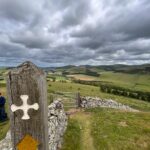
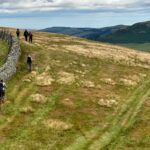
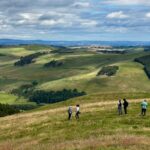
My personal journey with pilgrimage began with visiting the locations around Oxford with specific ties to C.S. Lewis, J.R.R. Tolkien, and the Inklings. Inspired by the Northumbria Community and the gift of Celtic Daily Prayer I discovered in 2016 St. Cuthbert’s Way and The Isle of Iona as opportunities to be with God along paths and in locations sanctified by the prayers of countless thousands of men and women through the centuries who have carved out dedicated time to be with God in the beauty of His creation. I first walked St. Cuthbert’s Way with my daughters and son-in-law and then discovered how I could share this experience with others through Coracle. Since 2018 I’ve been transformed by walking in pilgrimage with others from around the United States who shared my hunger for unhurried time in communion with God in the company of others.
Pilgrimage has become part of my annual rhythms. For me it is an opportunity to reset, to process the richness of the year behind and free myself to be available to God for the year ahead. As one of our Coracle St. Cuthbert Way pilgrims expressed it this summer, it is an opportunity to release the stress of multi-tasking and embrace the solo task of walking in the company of God.
The power of pilgrimage is the freedom to turn one’s attention to one’s own fully embodied being in the context of the restorative power of beauty. Pilgrimage affords the opportunity to be fully present to the place where my feet are and with that attunement to one’s body comes an awareness of my thoughts, emotions, and deepest desires. The settledness of walking creates space to listen to one’s heart as it responds to God’s invitation, “What do you want Me to do for you?” And then to have the margin and capacity to listen to His gentle, compassionate response.
Traveling in the companionship of like-minded seekers, hungry for God, speaks to our deep cry to be a part of a community that sees us, holds safe and secure space for us, and soothes us in our core longings. We discover that words come over time. Both our longings and God’s tender replies cannot be hurried. Whether it’s guidance, insight, healing, consolation, or companionship or all of the above that we desire, the pace of walking ushers us into a natural rhythm of engagement and solitude, joy and peace. And it is out of these rhythms that our hearts experience the safety and security to emerge and reveal our deepest core longings lying, often unattended to, beneath our many surface desires.
Labyrinths, retreat centers like Corhaven, wooded paths, ocean and lake shores all provide opportunities to move at the pace of love in the midst of the multitude of God’s expressions of creative beauty as we wander through the flowers, the trees, the birds, the bubbling brooks, and ocean waves. The rocks cry out of the glory of God.
And so Abba Father, Jesus, and Holy Spirit invite us, “Come be with Us in an unhurried space surrounded by the beauty of our love. Explore with us what that might look like for an hour, a day, a week. Explore with Us how these rhythms can be incorporated into your ordinary days, weeks, and seasons. At the heart of all creation is Our trinitarian love for you and desire to be with you both uniquely and in the company of others who share our bond.”
A short reflection on Pilgrimage from Eric Coblentz, who served as our co-leader on our St. Cuthbert’s pilgrimage:
Journey. Pilgrimage. Strangers. Exiles. When we hear these words, we think of movement. Movement of the body, of course. But there’s a deeper, more intimate objective in the movement. It’s a journey of becoming. Kwok Pui-lan, an Anglican theologian posits that there is a third space or an in between space whereby movement happens within a person’s soul. It’s the liminal space or borderland, the in between the past and the future, known and unknown. Celtic Christianity may call this a thin space. These are sacred spaces or times where people experience a sense of God’s presence. It evokes openness to the Trinity.
What do thin spaces have to do with pilgrimage? A pilgrimage is a journey into those thin spaces with God. It’s less about the end goal of arriving and it’s more about what one carries on the journey. The thin spaces are found not in the final destination of pilgrimage, but rather in the journey of the pilgrimage itself. It’s both the physical travel and the internal spiritual transformation that occurs on the journey. In a pilgrimage we realize we are always in the process of becoming someone. We are in transition physically, but we are all wanderers in our own spiritual world continually being transformed.
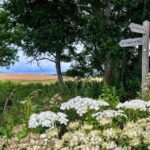
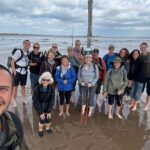
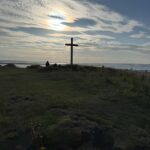
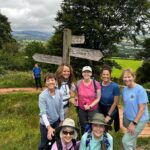
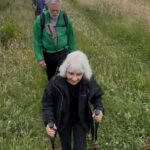
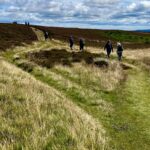
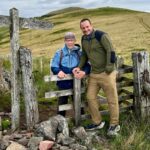
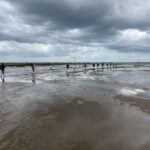
A few photos from the pilgrimage: