
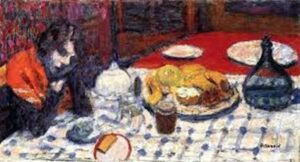
The Checkered Table Cloth by Pierre Bonnard, 1947.
“Love”
by George Herbert
LOVE bade me welcome; yet my soul drew back,
Guilty of dust and sin.
But quick-eyed Love, observing me grow slack
From my first entrance in,
Drew nearer to me, sweetly questioning
If I lack’d anything.
‘A guest,’ I answer’d, ‘worthy to be here:’
Love said, ‘You shall be he.’
‘I, the unkind, ungrateful? Ah, my dear,
I cannot look on Thee.’
Love took my hand and smiling did reply,
‘Who made the eyes but I?’
‘Truth, Lord; but I have marr’d them: let my shame
Go where it doth deserve.’
‘And know you not,’ says Love, ‘Who bore the blame?’
‘My dear, then I will serve.’
‘You must sit down,’ says Love, ‘and taste my meat.’
So I did sit and eat.
The essence of the heart of God is love. The Trinity created us in love, pursues us in love, and rescues us in love. Our very existence, both in its origin and in its daily unfolding, relies on God’s love being the underlying reality of all existence. St. John of the Cross beautifully depicts this generative, relational love of God in his Romances.

Mary and Jesus. Found in St. Mary’s Episcopal Cathedral in Edinburgh, Scotland. Photo by Scott Buresh.
What is the essence of love?
Josef Pieper, the respected Catholic German philosopher and Aquinas scholar, undertook an extensive study of love and distilled it down to two fundamental qualities:
- Delighting in the beloved’s existence (I’m glad you are alive. I’m glad you are you.)
and
- Commitment to the well-being (the very best) of the beloved
Pieper’s distillation corelates beautifully with the Hebrew understanding of hesed being God’s steadfast covenantal love for His creation and Paul’s use of agape love in I Corinthians 13. “I have loved you with an everlasting love – out of faithfulness I have drawn you close.” (Jer. 31:3)
We cannot continue, let alone flourish, without God’s loving care pursuing us all the days of our lives (Psalm 23:6a).
A world dominated by fear rooted in lust and pride
And yet we live in a world dominated by fear of harm and loss. We are both the victims and perpetuators of “injury which brings pain and loss, then fear and anger, which mingle with resentment and contempt and settle into postures of coldness and malice, with brutal feelings that drain the body of health and strength and shatter social well-being” (Renovation of the Heart, p. 131).
So how do we break the chain of injury rooted in insecure attachment to God’s love for us? Theoretical assent to God loving us is not enough to heal the pain of our human experiences of not being loved.
Healing begins with Jesus loving us
I vividly remember the first time it was explained to me that Jesus suffered torture and crucifixion out of love for me. I recognize now that there was the unseen power of the Holy Spirit in that moment enabling me to see and comprehend that act of love over 2,000 years ago being for me. I was overwhelmed with a deep sense of gratitude and desire to enter into a secure, loving relationship with Jesus.
There is great power in reading the accounts of Jesus’s interactions with the weak, the poor, the dispossessed and possessed, the arrogant and the humbled, the powerful and the marginalized to stir a sense of confidence in His love for all people, including me.
St. Ignatius, through imaginative engagement with Scripture, provides a wonderful way of helping us personally experience Jesus’s love as if we were present in real time with Him. I have found this to be critical to moving beyond intellectual assent to embodied confidence rooted in experience. (Hebrews 11:1)
Yet what about the experiences of pain and harm in my lived reality? What about my actual fear and anxiety and temptation to try to control others and outcomes rooted in my own experiences of wounding and shame?
One of the greatest gifts I received from the Coracle Fellowship was from the very first retreat when Bill Haley encouraged us to reframe the question “God, do you love me?” to “God, how are you loving me in this?” By His grace I’ve learned that I can ask Him how He is loving me in my current circumstances.
I’ve also experienced through imaginative healing prayer that I can ask Him how He was loving me in past circumstances. This kind of prayer takes tremendous courage as it is incredibly vulnerable and not to be done lightly. I have found the support of wise counselors, spiritual directors, and healing prayer ministers (yes, I have used them all!). What a gift to gain glimpses into the unseen reality of His tender loving care comforting and protecting me through all the seasons of my life.
Security in God’s loving presence overflowing to loving others
Being securely loved builds a sense of strength and hope and trust that dispels our fear (I John 4:18) and our pride and the self-protectiveness that keeps us from loving our sisters and brothers (I John 4:7), our neighbors, and even our enemies (Matthew 5:44-48). The Rev. Dr. Martin Luther King, Jr., in the height of violent resistance to the Civil Rights Movement, compiled a series of sermons titled Strength to Love. Love takes courage. Love takes effort and investment.
As I increasingly experience His love, I have noticed that I have increased courage to step out and risk more; to see people as beloved image bearers of God, uniquely and beautifully created rather than threats to be feared. In my best moments I am freed to hear their stories and to not be shaken when interacting with those who are not able to love me in return.
So where do I find the strength to love?
By putting myself in positions to be loved. This cannot be forced or hurried. God is patient, waiting like Aslan with Shasta in The Horse and His Boy to be invited to speak (Rev. 3:20). His heart is safe, secure, and welcoming, asking us as we witness Him in the garden asking Adam and Eve “where are you?” And Jesus repeatedly asking those he encountered “What do you want me to do for you?”
Love is wonderfully generative (Eph 2:10). As we allow ourselves to be loved we will naturally find ourselves responding in loving gratitude to God. And as we love one another we will find ourselves increasingly being drawn to love our neighbors! And while not a seamless formula we can work, the more we love others the more we will find ourselves being loved in return.

On St. Cuthbert’s Way near Eildon Hills. Photo by Scott Buresh.
How do we cultivate love?
Here is a brief list of avenues I have found to be fruitful in growing in love. I offer this as a catalyst for making your own list drawing from your own experiences of being loved.
- Extended unhurried quality time together with God
- Imaginative prayer
- Lectio divina
- Pursuing beauty and expressions of creativity
- Listening to lullabies and worship songs in God’s presence
- Long walks in the woods and along the beach
- Soaking in images of Jesus through the Gospels and Scripture more broadly (Ignatian Exercises)
- John leaning against Jesus’s breast
- Jesus walking with Peter
- Jesus inviting Peter to join Him on the water
- Jesus with the Samaritan woman
- Jesus with Mary and Martha
- Prodigal Father
- Jesus with the woman caught in adultery
- Jesus enduring torture and abuse
- Jesus forgiving even His accusers and executioners
- Jesus’s compassion for the marginalized, neglected, weak, ill, and tormented
- Jesus’s invitation to just be with Him (Mt. 11:28-30)
- Pursuing corrective experiences
- Meeting with a care provider, spiritual director, counselor, mentor, friend
- Choosing to be in loving community (as someone who lives alone, I appreciate the initiative this requires)
How do I know experientially God loves me?
- Intimate encounters in prayer
- Intimate encounters with people
- Images and stories from the gospels and scripture
- Stories/testimonies of others
- Encounters with nature
- Encounters with beauty
- The whole character and nature of Jesus expressed in the Gospels
- Personal encounters with Jesus
- Personal encounters with His people
- Experiences of being loved and of loving
- Experiences of the qualitative difference love makes when I care for another rather than operating out of fear or pride or lust
- Observing loving people
I encourage you to take time to make your own list, from your own experiences, or from this list – whatever speaks to you. As Curt Thompson reminds us, it is critical to pay attention to what we are paying attention to, and these suggestions are an encouragement to pay attention to where we experience being loved. I am always encouraged to hear from you, and would be delighted to respond to any questions or thoughts these suggestions may have raised for you. May we all grow ever more secure in Abba’s delight in us!