
by Jeannie Rose Barksdale | Founder of Tangible & Spiritual Director
“How can you tell a story about something ordinary that would be very interesting?”
This was a friend’s honest question in response to my invitations—over summer months in the liturgical calendar season of Ordinary Time—to share stories of finding deeper meaning, of encountering God, in the ordinary.
“Maybe it takes someone who’s good at creative writing,” he wondered, implying, “and I’m not that someone.”
It’s a worthwhile question, and I want to share my answer, make the case for finding meaning in the ordinary. But in case the bustle of life sets in before I get there, I first want to extend a similar invitation via a different question: have you ever witnessed a quiet display of virtue, off stage, off camera, sans fanfare?
I recently witnessed such a moment while driving my kids. A man struggled to wheel across an intersection and someone walked over to check on him, offer a hand, accompany him across. Simple. But I could tell my children 100 times to look out for others, seek to serve, and make less progress than this man’s life created in a moment of a memorable object lesson. Stories do that for us.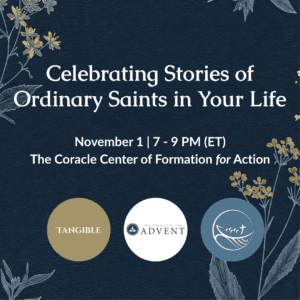
Ordinary Saints on November 1 at the Coracle Center offers us a chance to share stories like this. We’ll celebrate the good, the true and the beautiful bubbling up in mundane lives and hidden faithfulness. Whether you offer a story of someone who has been that for you, or simply bask in the encouragement of these living object lessons, I hope you’ll join the party! (Tickets available here.)
Back to my friend.
How do you make something ordinary interesting? We could as well ask what it means to live an interesting story, situated in what feels like a not-very-interesting life—what it means to live well. In the decade since my father died, I’ve been asking these questions, sharing my stories of finding the glorious and divine in the tangible and mundane on Tangible.
What have I learned?
To start, any ordinary thing (or person!) can be interesting—by making the choice to give it our interest. When we pay attention, the ordinary reveals a host of interesting stories and becomes a launching pad for an encounter with God. (Are you brave enough to give it a try—with a guided meditation on folding laundry?)
You’ve probably seen the Elizabeth Barrett Browning lines on a tote bag: “Earth’s crammed with heaven, and every common bush afire with God; But only he who sees, takes off his shoes—The rest sit round it and pluck blackberries.”
While the rest sit around and pluck blackberries, what is he who sees God doing?
He’s right there in the plants, doing the laundry, same as everyone else. But he pays attention. Close examination of plants may yield any number of interesting stories. But the great latent power of an ordinary plant is that it is secretly afire with God.
The blackberry bush afire with God becomes a window to an enchanted world overlaying the one we’re living in, where beauty astonishes, where gratitude infuses, where a simple object conveys ultimate truth. A plant may amaze you with glorious symmetry. A man may transcend his self-absorption to aid a stranger crossing the street. If wherever you cast your gaze is crammed with heaven, watch out—pause to see, and a fragment is bound to burst forth and grab hold.
This matters because ultimately, the real invitation is not to tell an interesting story. It is to live well.
If the only way to do this is something more, something else, we are destined for discontent. Believing the good life is somewhere else is a temptation we’ve been prone to since the beginning. But what if living well was not confined to a mountain high, but was ours to enjoy in the everyday life of the valley?
Look, we know the good life isn’t about what’s in our bios or bank accounts; it’s a cliché that resume accomplishments won’t be heralded at our funerals. We’ll be remembered instead by our witness and character, moments of sacrifice, patterns of love. In fact, it was my own father’s funeral that launched this journey for me—a story I’ll be telling on November 1.
But this doesn’t come easily. Blackberries are delicious. Our phones are addictive. People are rarely introduced by their virtues and acts of service. Long obedience in the same direction can feel like thankless drudgery. How do we anchor ourselves to the slow, invisible work of cultivating a life of joy, purpose, communion with God and service to others?
Stories do that for us.
When people say storytelling makes us human, I think they’re getting at how stories provide a window into a longer arc than we can see from our time-bound perch, a sort of time lapse of reality. As we live our own stories in agonizingly slow real time, we need the stories of those who have gone before, ordinary saints who have run the race whose examples light the way of those still traveling. Stories foster the community we need to press on as they allow us to behold each other, bear witness to our changes or challenges, share burdens and joy. They form living object lessons that let truth sink deep in our bones in ways a sermon—or a parent’s lecture—never could.
George Eliot closes out Middlemarch with a picture I’ve come to see as aspiration for the kind of good life you or I might lead: The growing good of the world is partly dependent on unhistoric acts; and that things are not so ill with you and me as they might have been, is half owing to the number who lived faithfully a hidden life, and rest in unvisited tombs.
Whose hidden faithfulness has left you not so ill as you might have been?
We need the encouragement this story offers. Won’t you come share it November 1?